 Social Liberty
Irreconcilable Differences
Right and left libertarians share a name, a premise, and most of a platform. They split on one word, and the split can't be negotiated, because each side's liberty is the other side's aggression.
Click to enlarge
Two groups of people call themselves libertarians. They oppose the same wars, want the same drug laws repealed, defend the same speech, distrust the same police powers, and start from the same moral premise: that every person belongs to themselves and nobody may start using force against them. Put a right libertarian and a left libertarian on a panel about surveillance or conscription and the audience would struggle to tell them apart.
Then someone mentions a landlord, and the panel is over.
The disagreement over property is usually treated as a difference in emphasis, as if the two camps were standing at different points on the same line and could meet somewhere in the middle with enough goodwill. They can't. The divide isn't about how much property rights should count. It's about which acts count as force in the first place, and both sides answer that question by pointing at the other side's liberty.
A walk down any street
Picture we are walking down a random street in our mind. We have two visions. In the first is a frame of private property: many lands are fenced off and excluded from our egress. In the second is a frame where all property is public property, meaning we can walk anywhere we want.
Which has more liberty?
The question sounds like it should have an obvious answer, and it does. The trouble is that each camp finds a different one obvious. The left libertarian looks at the fences and sees exclusion enforced by someone else's claim: every gate is a place we may not go, and nobody asked us. The right libertarian looks at the open street and asks where, in that second vision, anyone may close a door. If every piece of ground is open to everyone, then no one has a garden they can plant without a passerby trampling it, a workshop they can lock, or a home they can refuse to share. The fence that keeps us out is the same fence that would keep others out of what's ours.
Neither camp actually proposes either picture in full. Almost no left libertarian wants strangers walking through their kitchen, and almost no right libertarian thinks the sidewalk should be a toll road. But the thought experiment shows where the split comes from. Liberty to move and liberty to hold are both liberty, and every fence trades some of one for some of the other. The answer to "which street is freer" depends on whether we picture ourselves as the one walking or the one who lives behind the gate, and in any real town we're usually both.
Where the word came from
The fight is older than either camp's current membership. The word "libertarian" in its political sense was first used by the French anarchist Joseph Déjacque, who in 1857 called himself a libertaire in an open letter attacking Proudhon from the left. For roughly a century after that, across most of Europe, "libertarian" meant anarchist or libertarian socialist: someone opposed to the state and to the private ownership of land and capital, usually in the same breath.
The American right adopted the word in the 1950s and 60s. Murray Rothbard later wrote, with some satisfaction, that his side had captured a crucial word from the enemy. Outside the United States, the older meaning still dominates. A Spanish libertario or a French libertaire is more likely to be marching with a black flag than reading Ayn Rand.
So the two camps aren't a movement that split. They are two movements that ended up with the same name, and the name has been disputed from the start.
What they share
Take the common ground first, because it's larger than either side usually admits.
Both camps hold that a person owns their own body and labor. Both hold that the state is, at best, a dangerous necessity and, at worst, organized theft. Both would abolish or sharply limit most of what modern states do to individuals: surveillance, conscription, censorship, the drug war, licensing schemes that keep people from working. Both put voluntary association at the center of a good society. Both treat the non-aggression principle, or something close to it, as the moral test for any use of force.
That shared premise is exactly what makes the divide so bitter. The two camps aren't arguing from different values. They're arguing from the same value to opposite conclusions, and each thinks the other has betrayed a principle they both claim.
The right-libertarian chain
The right-libertarian argument runs in a straight line.
A person owns themselves. They therefore own their labor. When they mix that labor with something nobody owns (clearing a field, fencing a pasture, sinking a well), the result becomes theirs, because separating it from them would mean taking their labor. What they own they may trade, give away, rent out, or leave to their heirs. And whatever comes out of a chain of just acquisitions and voluntary transfers is itself just, however unequal the result.
Robert Nozick gave the cleanest version in Anarchy, State, and Utopia: justice in holdings is a matter of history, not pattern. Ask how a holding came about, not whether the resulting distribution looks fair. If every step was voluntary, the outcome is legitimate, whether it leaves one person with a sandwich or one person with a province.
On this view, full private title to land and capital isn't an extra policy bolted onto libertarianism. It is self-ownership, extended outward into the world. Taxing a landowner's rent, occupying an empty building, or letting workers take over a factory they don't own are all the same act: someone using force to take what another person justly holds.
The left-libertarian chain
The left-libertarian argument starts from the same place and turns at the second step.
A person owns themselves, and they own their labor. But land, minerals, water, and the electromagnetic spectrum aren't anyone's labor. They were there before anyone arrived. Mixing labor with them gives a claim to the improvement: the crop, the house, the well casing. It doesn't give a claim to the ground itself, because the ground was never the worker's to begin with, and fencing it off takes something away from everyone else who might have used it.
This is a whole family of positions, not one. The philosophers Hillel Steiner and Peter Vallentyne defend a left-libertarianism of self-ownership plus equal shares in natural resources, where whoever holds more than their share owes the rest a rent. Thomas Paine said something similar in Agrarian Justice in 1797: cultivated land is private, but its owner owes the community a ground rent for the natural value it absorbed, to be paid out as a dividend to everyone. Henry George built a program on that. The American individualist anarchist Benjamin Tucker, a free-market man through and through, held that land was legitimately held only by occupancy and use: a person owns the field they farm and the house they live in, but not a field they have never seen and rent to someone else.
Further left, Proudhon drew his famous line between possession, the right to hold and use what one occupies and works, which he defended, and property in the sense of a titleholder's right to collect from someone else's labor, which he called theft. The libertarian socialist tradition that followed extended the same logic from land to factories: those who work the machines have the claim, not the absentee holder of the deed.
What these positions share is the move at step two. Self-ownership stops at the boundary of what a person has actually made or actually uses. Beyond that boundary, a title is a claim on other people's liberty, not an expression of the owner's.
The same act, two descriptions
Here is why the divide can't be split down the middle.
Both camps agree that initiating force is wrong. But force against what? The non-aggression principle only tells anyone what counts as aggression once a theory of property has already said who owns what. Push someone off land they own, and it's aggression. Push them off land they don't own, and it's defense. The principle can't decide which is which. Property decides, and then the principle applies.
So take any contested act and each camp describes it in opposite terms, both using the language of non-aggression:
| The act | Right-libertarian description | Left-libertarian description |
|---|---|---|
| A landlord evicts a tenant | An owner exercises a right; the tenant who refuses is the aggressor | An absentee claimant uses the state's force to expel the actual occupant |
| Workers occupy a factory the owners closed | Theft of capital | Occupants claiming what they use and the owners abandoned |
| Squatters move into a building left empty for years | Trespass | Occupancy and use, against a title with nothing behind it |
| A tax on the rental value of land | Confiscation of a just holding | The community collecting what the titleholder took from it |
| A fence around unused land | Securing what's mine | Excluding everyone else from the common inheritance by force |
None of these are hypothetical. After Argentina's financial collapse in 2001, workers took over hundreds of shuttered businesses, including the Zanon ceramics plant in Neuquén and the Hotel Bauen in Buenos Aires, and ran them as cooperatives. In the Netherlands, squatting buildings left empty for over a year was tolerated and partly legal until a 2010 ban. In each case both sides accused the other of starting the force, and both were right by their own theory of property.
That is the irreconcilability. It isn't that the two sides weigh the same values differently and could split the difference. Each side's central freedom, my title protects me on the right and my use protects me on the left, is exactly the thing the other side names as the aggression. A compromise that gives the landlord half the building isn't half of liberty to either camp. To both, it's half a crime.
Why the usual bridges fail
Libertarians on both sides have tried to cross this, and the attempts tend to fail the same way.
Right libertarians sometimes concede Locke's proviso, that appropriation is just only where "enough, and as good" is left for others, and then argue that markets satisfy it by making everyone richer than they would be in a state of nature. But that turns a question about rights into a question about outcomes, which is the move right libertarians reject everywhere else. If being better off in aggregate justifies an enclosure, it would justify a great deal of redistribution too.
Left libertarians sometimes concede that some private title is needed for security and planning, and then argue for leaving personal property alone while socializing the rest. But drawing the line between "personal" and "private" property takes an authority to draw it, and that authority begins to look like the state both camps set out to abolish. A cooperative that votes on who gets to use the workshop is still one group deciding what another person may do with their labor.
Rothbard's own attempt to handle the history is instructive. In The Ethics of Liberty he argued that titles traceable to theft or conquest should go back to the victims or their heirs. Where the victims can't be identified and the titleholder descends from the conqueror, as with the great landed estates of Latin America, the land should pass to the peasants who actually work it. That is, remarkably, the occupancy-and-use position on a great deal of real land. It's the right-libertarian argument conceding, at the level of history, the claim it resists at the level of principle, and leaving open how many present titles could survive the same test.
Where the seam runs
If there's a way through, it isn't a compromise between the two positions. It's the observation that they disagree about two different kinds of thing, and the word "property" hides which one is at stake.
On what a person makes (the tool, the coat, the harvest, the house they built, the business they started from nothing), the left-libertarian argument has very little purchase, and the most serious left libertarians don't press it. Tucker, George, and Steiner all defend it. On what nobody made (land, water, minerals, the location itself), the right-libertarian argument has a hole in the first link, because no labor created the thing being claimed. That's the point where the Georgist and occupancy positions sit, and it's the one place both camps could stand without giving up their premise, only its most absolute reach.
That wouldn't end the divide. It would ask the right to give up land absolutism and the left to give up collective title to capital that people have actually built, and plenty on both sides will refuse. The capital question in particular, whether owning a factory someone else works is more like owning a coat or more like owning land, is where the next round of the argument lives, and this draft doesn't settle it.
But it does move the argument off the question that can't be answered. "Is property liberty or is property theft?" has two fixed sides and no possible ground between them. "Which kinds of holdings trace back to someone's own labor, and which trace back to a fence?" is a question both camps can actually argue about, using the one premise they already share.
More on Categories
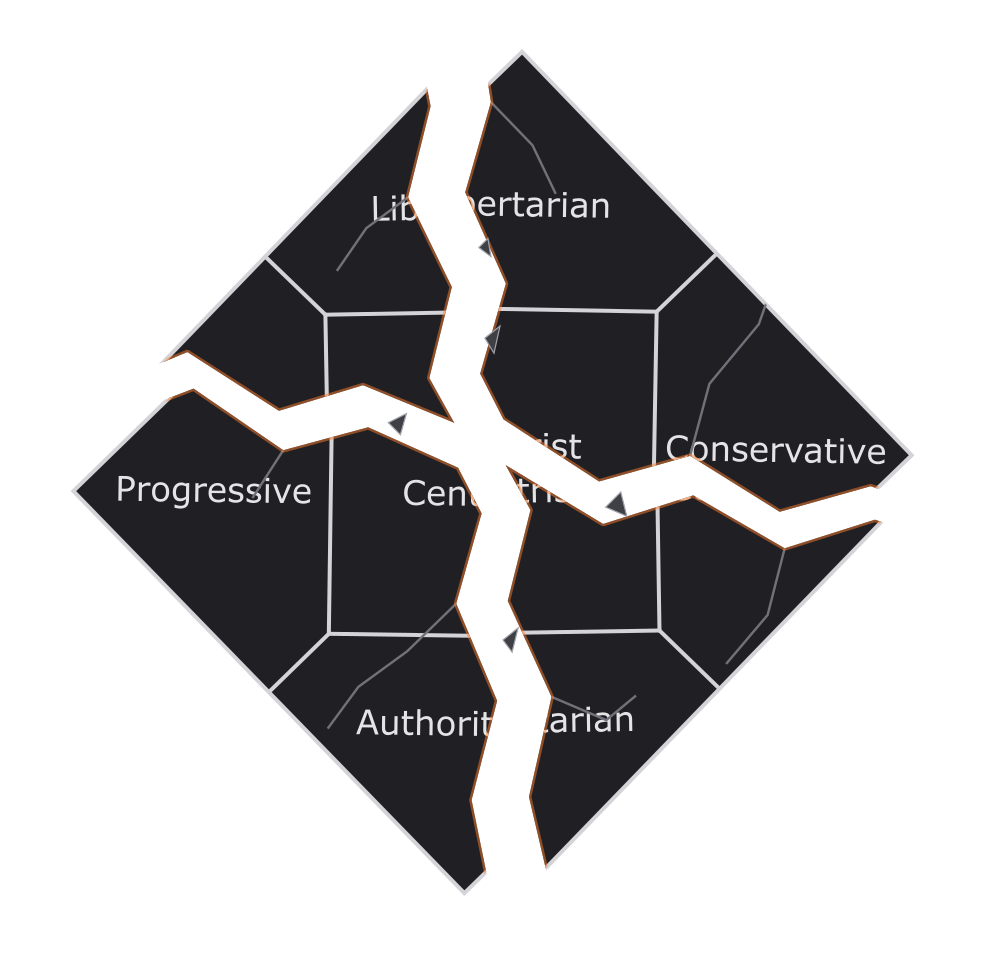
The usual starting point for sorting political positions past a single left-right line is the Nolan chart, drawn by David Nolan, one of the founders of the American Libertarian Party, around 1970. It has two axes, personal freedom and economic freedom. High on both puts someone at the top, as a libertarian. Low on both puts them at the bottom, as an authoritarian. High on personal freedom and low on economic freedom is the progressive corner, and the reverse is the conservative one. The chart was a real improvement on the single line, because it showed that "left" and "right" were each half-libertarian and half-authoritarian, just on different halves.
But the chart carries the divide this essay is about inside it. Its "economic freedom" axis measures freedom as the right libertarian defines it: absolute title, untaxed exchange, no claim by anyone else on what's held. On that scale a land value tax scores as a loss of economic freedom, so Paine, George, and Tucker all get pushed down and to the left, toward the authoritarians, for holding that nobody made the ground. The chart can't place a left libertarian where one would place themselves, because it settled the property question before anyone filled it in.
The labels have a second problem. "Progressive" and "conservative" originally described an attitude toward change: whether to try the new thing or keep the old one. The chart and the parties use them as team names for a bundle of positions on property and the state. Put the words back on their original meaning and the teams don't line up with them.
Take technology, and AI in particular. The American right has mostly argued to let AI development run: fewer rules up front, federal preemption of state AI laws, and a bet that the gains will outrun the harms. The left has mostly argued for licensing, safety review, bias audits, and slowing deployment until the risks are understood. Whatever the merits, the first stance is the progressive one in the plain sense of the word, and the second is the conservative one. The same pattern shows up in nuclear power, gene editing, and self-driving cars. On the new thing, Republicans are more often the ones saying try it.
The Democratic program, meanwhile, is less progressive than socialist, in the older sense of collective provision. Its center of gravity is the state as provider and redistributor: of health care, housing subsidy, tuition, and income. And where Democrats hold power locally, they often defend the status quo against change. Zoning that freezes neighborhoods in place, environmental review that stops new housing and transit for years, and protection of incumbent unions and institutions are all conservative in the literal sense, whatever the party calls itself. The label "progressive" sticks because it names an aspiration, not because it describes a stance toward change.
None of this makes the right the party of liberty. It has its own preservationist streak on culture and borders, and its enthusiasm for new technology often ends where a favored incumbent industry begins. The point is that "progressive," "conservative," "left," and "right" each fold several independent questions into one word, and the folding hides where people actually stand. At minimum there are three questions. What may be owned, and on what terms? How much power may the state hold over persons? And how much should we welcome change? The Nolan chart answers the second and quietly assumes the first. The party labels pretend to answer the third and mostly don't. A map that asked all three separately would find right and left libertarians agreeing on the second, split on the first, and scattered across the third, which is roughly where this essay found them.
A note on how this piece was written: every argument, source, and structural decision in this essay is mine. I chose the examples, worked out the logic connecting them, and directed what each paragraph needed to say. The sentences themselves were drafted with AI assistance from that outline and then edited by hand. I'd rather say that plainly than have a reader guess at it.