 Social Liberty
The Park
A view from three cultures
Third in a series, following Cultures of Life and Death and Three Cultures.
Take the abstraction out of the last two essays and put it somewhere concrete: a public park, on an ordinary afternoon. Not a private club and not somebody's back lawn — the public good, in its landed form, on behalf of everyone who might want it, which is what makes it the right test case.
And it's not just held, the way a trust holds a stock portfolio untouched. It's built: graded, planted, fenced, gated, permitted, repaired, or deliberately left alone — a continuous, ongoing act of construction, not a one-time inheritance a custodian merely guards.
"Park" here is just the landed form of a more abstract question: what posture does government take toward constructing the public good it's responsible for? Three different answers show up within a twenty-minute walk, each one already built into stone, signage, and a fence line, doing exactly what the postures from the rest of this series do at civilizational scale — except this time it's not a metaphor for the state, it's the state, building actual land on actual people's behalf.
What are public parks for?
Ask this before the harder question, because it's the one the harder question quietly assumes an answer to. A park isn't shelter, isn't food, isn't anything a body strictly needs — nobody dies without one. What it offers instead is room: a place to be outdoors without owning outdoors, to let a dog run, a kid climb, a couple sit on a blanket doing nothing in particular, that isn't anyone's driveway or backyard and so isn't anyone's to say no to. It's the closest thing a dense, deeded, fenced-off world has to open ground — not commerce or trespass, just space held loosely enough that showing up in it doesn't require an invitation.
That's a modest function, and it's easy to build past it — to decide the park should also teach civic virtue, or generate revenue, or showcase good design, or eliminate every conceivable risk, until the actual thing it does (make room) gets buried under everything it's been asked to also do. Most of what follows is what happens when a park's caretakers forget that room was ever the point.
Is there such a thing as a public good?
Before walking the park at all, the premise underneath it deserves a beat: does "public good" name anything real, or is it a euphemism for whatever a government decides to build with money it took from people who never asked for it?
Social libertarians answer yes, but only under two conditions the phrase usually gets to skip. First, it has to be optional — nobody is compelled to fund it, use it, or defer to it, the way a park stays a public good and not an imposition only as long as staying away costs you nothing but the park. Second, it has to come at no expense to the people who have no interest in it — a public good paid for by conscripting the indifferent isn't a public good, it's a private elite power preference laundered through the tax code and a nicer noun.
That's a narrower target than most conceptions of the public sector allow themselves, but it's what keeps the phrase from collapsing into whatever the fenced-and-gated end of the park already does: build a thing, then compel everyone's participation in maintaining and paying for it whether or not they ever wanted it built. A public good that clears both bars is still a live category — genuinely held in common, genuinely open, genuinely nobody's imposition on anybody else. It's just rarer than the label gets used for, and the three scenes below are, among other things, a way of asking which of them still qualify.
The fenced, concreted, even gated park
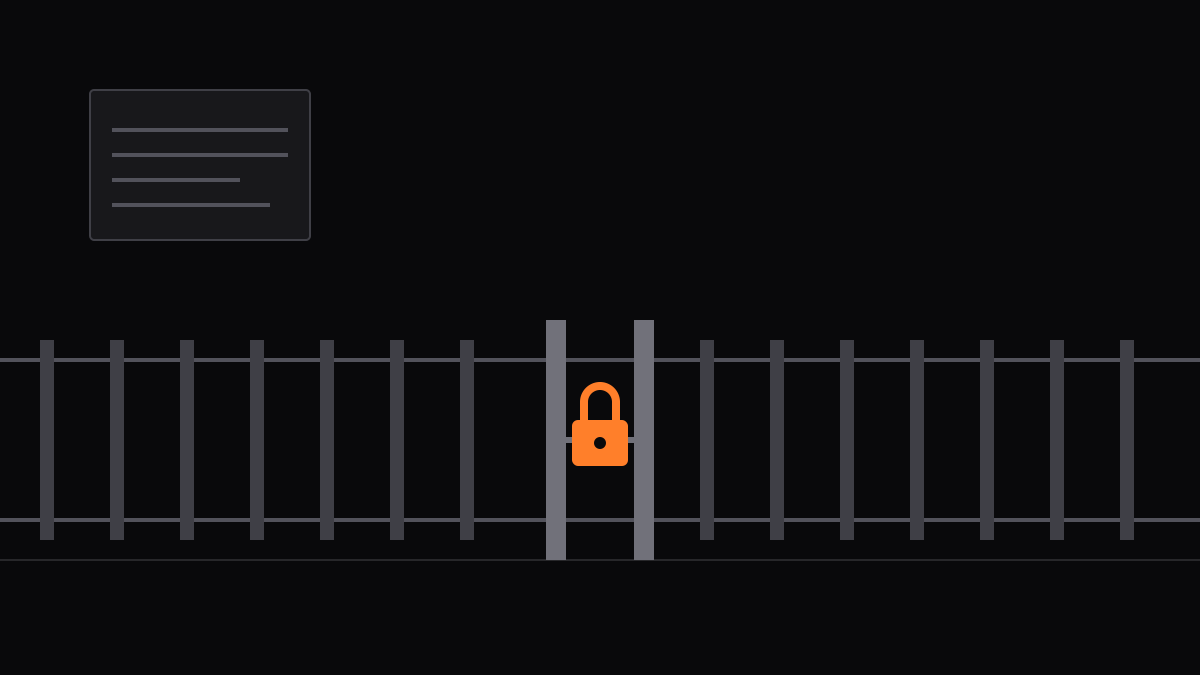
Start at the municipal end. Every surface here has been reasoned about by a risk manager. The play structure is rated for ages 5–12 and fenced off from the swings rated for ages 2–5. A sign lists eleven prohibited activities. The grass is closed for reseeding four months a year.
Nothing is technically dangerous, and nothing, as a result, is quite alive either — the stillness isn't peace, it's the particular quiet of a space organized entirely around what must not happen in it.
This is the overvaluing posture, built out of steel and liability law: a park loved so anxiously that loving it consists mostly of restricting it. It's also John Paul II's calculus of convenience running the other direction — not removing the burdensome, but removing the possibility of burden, which quietly removes most of what made the space worth visiting.
Durkheim's mechanical solidarity shows up here in miniature: cohesion purchased through uniformity, a rulebook that holds together precisely by deciding, centrally and permanently, what's allowed on a given day.
Nothing here is against the law — no ordinance broken, no deed transferred — but nothing is moving either. A public good administered this way produces the same stillness as one that's actually been privatized: land held by an agency and defended from its own public, not land used by them.
The worn park
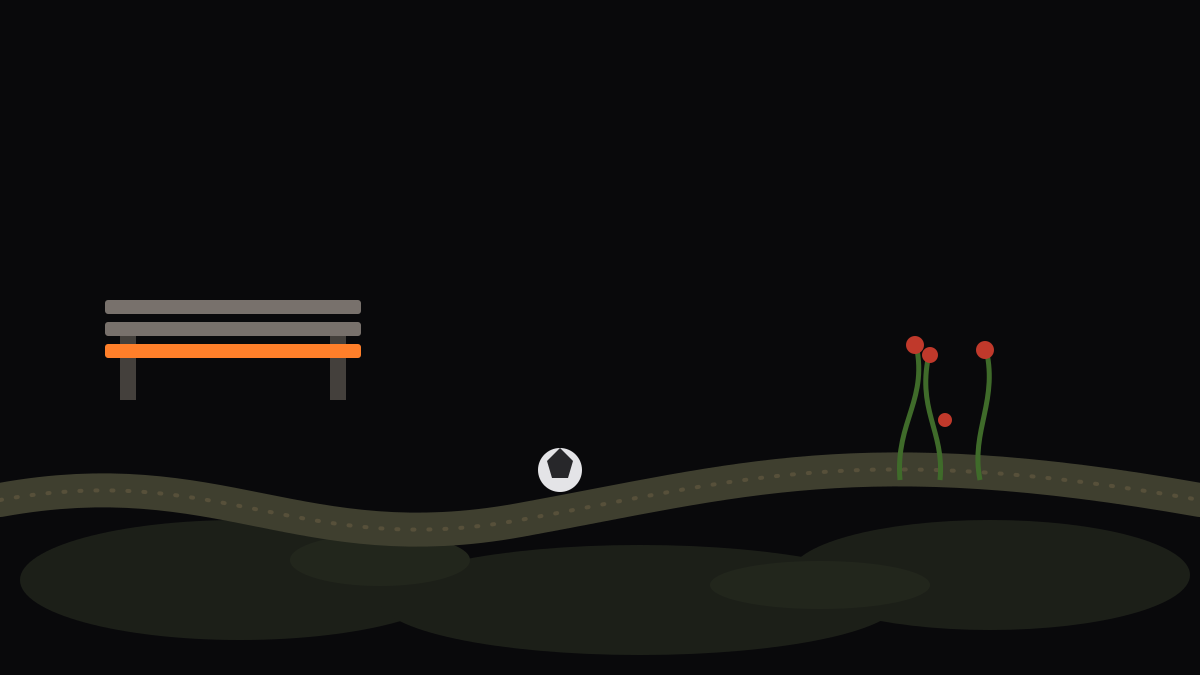
A third has no gate and hasn't been reseeded in years. The grass is patchy where a soccer game runs most evenings. A resident planted the tomatoes along the south fence without asking anyone; nobody's torn them out. Somebody replaced a broken bench slat with a mismatched plank, and it's still the most-sat-on bench in the park.
Worn, but by wearing it also heavily used and popular. This is construction too — just distributed, incremental, never signed off by anyone with the authority to sign off on anything. The land is still being built; it's just being built by whoever happens to be standing in it that week.
Nothing here was planned by a single authority into its current shape — it got this way through several years of people deciding, individually and without coordination, what the space could hold, the way Durkheim's idea of organic solidarity gets its cohesion from interdependence rather than a uniform decree, the way a market order stays supple because no single hand is fixing its price.
This is Becker's alternative to the immortality project: nothing here is trying to last forever exactly as it is, so nothing here is brittle. It's the companion-of-life posture in landscaping — not risk-free, not curated, just still rearranging itself in response to what actually shows up.
The natural park
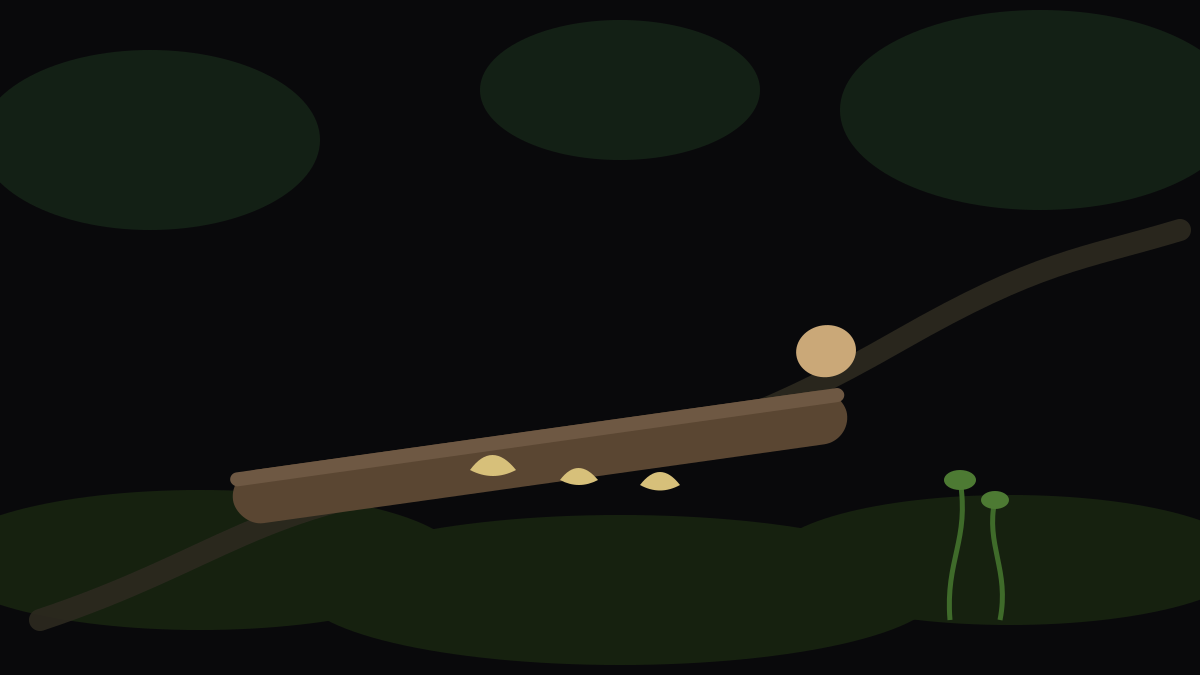
The third isn't landscaped at all. No irrigation, no reseeding schedule, no bench. A fallen oak lies where it dropped two winters ago, most of its bark already gone to beetles, a shelf of fungus working the underside; deer paths cut through the underbrush wherever the underbrush let them.
This, too, is construction — just not human construction. Nobody drew a plan for the fungus or permitted the deer path, but the ground is being actively built all the same, one decomposing log and one new sapling at a time; the land is constructing itself, on a timeline nobody manages and nobody needs to.
Nothing here is being protected from death, and nothing is being asked to hold its shape past its season — the log rotting into the soil is not a maintenance failure, it's the actual mechanism by which the next thing gets to grow.
This is the soft, pliant "ten thousand things" and the water that never stops moving, both from the rest of this series, without the metaphor doing any work at all: an ecosystem where the companion of death is not fenced out, not gated off, but folded directly into how the place stays alive. It's the closest thing in the whole walk to the first essay's argument taken literally — not a truce with death, not a defense against it, just proximity, unbraced.
How the three cultures view the public good
The three scenes are the same three postures from the rest of this series, applied to the thing government actually builds on everyone's behalf rather than to a person or a market. And each one carries a different vision of construction, not just a different attitude toward land already finished.
Dichotomies like this are hard to hold onto, because intensity of management is not the axis that matters. A heavily managed landscape can be natural or built — the fenced-and-gated park and the natural park can both, in principle, absorb the same number of hours of human attention; what differs is what that attention is for. The real question was never how much a park is managed, but how well the management surfs the oppositional dichotomies underneath it — life and death, vibrancy and peace — rather than trying to resolve them by picking one side and fencing out the other.
The fenced-and-gated end treats construction as a one-time act: engineer it correctly once, then spend everything after that defending the result — the sixty percent's relationship to life, applied to a design. Land here isn't being built anymore; it's being guarded against being rebuilt, which is why "public" comes to mean who owns it on paper rather than who gets to keep shaping it.
The worn park treats construction the way the companion of life treats living: never finished, never signed off, an ongoing collaborative build with no ribbon-cutting — which is what a public good actually looks like under something like subsidiarity, authority left where the building happens instead of pulled up into a department that has to pre-approve the tomatoes.
And the natural park treats construction the way the sage treats death: not a human project at all, land building itself out of what falls and what grows back, the most literal answer this series has given yet to what government does when it stops treating its own vision as the only vision the land is allowed to have.
It is really about parks — not a metaphor borrowed to make the point land better, but one of the places the point actually lives.
A culture's stance toward death — bracing against it, controlling access to it, or simply letting it be visible and unmanaged — doesn't stay philosophical when the thing at stake is held in common. It becomes a fence height, a permit fee, a bylaw about reseeding, a bench nobody official ever approved, a fallen tree nobody hauls away.
The first essay in this series argued that companion of life and companion of death are postures a single person moves between; the second argued the same postures show up as institutional physics, stiffness versus suppleness, applied to markets and states. The park is just where you can see all of it at once, on the same public land, without reading Laozi, Becker, Durkheim, the Stoics, or Evangelium Vitae at all.
You can just walk the twenty minutes and feel which ground gives a little under your feet, which one has already decided, on your behalf, exactly how far you're allowed to go, and which one never decided anything at all.