 Social Liberty
Symbols and Phenomena
A walk with the family dog is two acts at once: the one the dog is having and the one the neighbors are watching. On symbolic action, and how the weight of the social sphere regulates the liberty of a person, even within family.
Click to enlarge
Early, before work, a woman walks her dog to the field at the end of the street. The field is empty. Halfway across she unclips the leash and the dog runs, nose down, in long loops through the wet grass. Then a car slows on the road beside the field. Without deciding anything she calls the dog, and when he comes she clips the leash back on, a little more sharply than she needs to. She holds the leash short until the car is gone. She has a plastic bag in her other hand, held where it can be seen.
Nothing in those few seconds changed for the dog, except the leash. Everything changed for her. A moment before, she was walking a dog. Now she was showing someone that she walks her dog properly. The movements were nearly the same. The act was different.
That second kind of act is the subject here: the symbolic action, done less for its own purpose than for what it says to whoever might be watching. Symbolic actions are an ordinary and necessary part of social life. What's worth describing is what happens when the social environment grows heavy, with rules and signs and neighbors and cameras, and more and more of ordinary life, including life with our own families, shifts from the first kind of act to the second.
Two walks at once
The dog is having one walk. The biologist Jakob von Uexküll, whom both Heidegger and Merleau-Ponty read closely, described each animal as living in its own Umwelt, the world as it exists for that creature. In 1934 he described the tick's world as made of almost nothing but warmth and the smell of butyric acid. The dog's world is richer: the street is a dense text of smells, each post and hedge carrying news, the field a place of speed and other dogs. The dog's walk contains no symbols at all. Nothing he does is done for an audience. A dog can't perform being a well-behaved dog. He can only be one, or not.
The owner is having two walks. One is the same walk the dog is having, seen from the human end: the cold air, the pleasure of watching him run, the slow loop home. The other is a walk in a world of eyes. In that world the leash is evidence, the visible bag is evidence, the sharp "heel" when a jogger passes is evidence. Each says something to someone, and what it says is roughly: I am a responsible owner, I know the rules, there's nothing to report here.
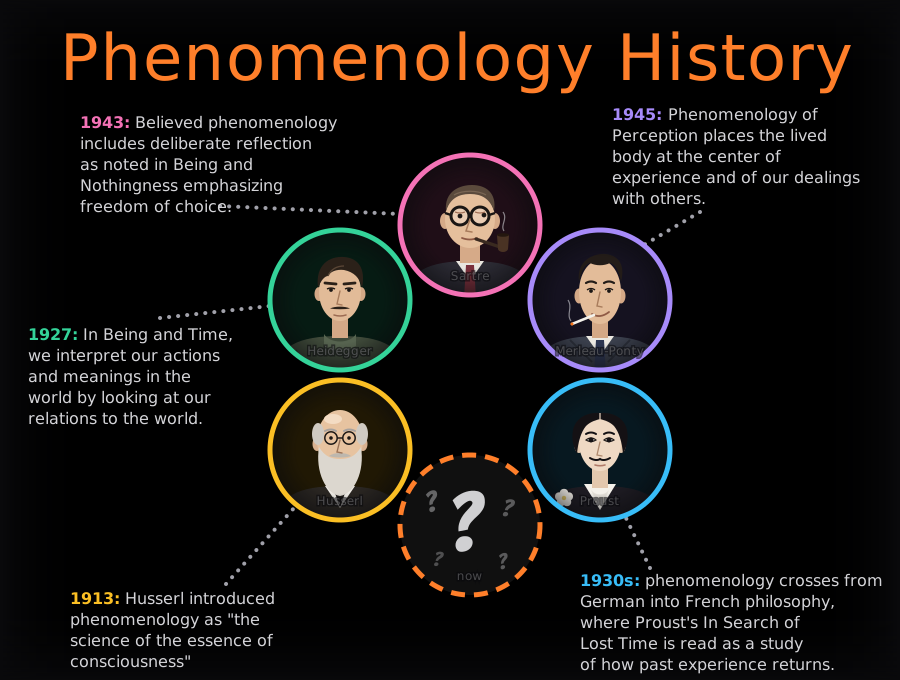
Edmund Husserl's basic observation about experience was that it is always of something. An act is defined not only by the movements of the body but by what it's directed toward. Clipping a leash because a dog is about to run into the road and clipping it because a car has slowed are, physically, the same motion. As acts they are directed at different things: the first at the dog, the second at the driver. The leash is the same leash. The woman holding it is, for that moment, doing something else.
The look
Jean-Paul Sartre, in Being and Nothingness (1943), described what happens to an act at the moment it's seen. His example is a man who, out of jealousy or curiosity, is crouched at a keyhole. As long as he's alone he isn't really aware of himself at all; he's absorbed in what's on the other side of the door. Then he hears footsteps in the hall behind him. In an instant he becomes, for himself, a man crouched at a keyhole. He sees himself as the other would see him, and he feels shame. Sartre called this the look (le regard). Being looked at doesn't just add an observer to an act. It changes the act, turning the actor from someone doing something into someone being seen doing it.
Sartre's other famous example is the café waiter whose every movement is a little too precise, too eager, too waiter-like. He is playing at being a waiter, performing the role for the customers so completely that the role begins to replace the man. The woman at the field, clipping the leash while the car idles, is doing a small version of the same thing. For a few seconds she is playing at being a responsible dog owner.
Martin Heidegger had described the background of all this in Being and Time (1927): das Man, "the they" or "the one." One keeps one's dog leashed. One doesn't let children cross the road alone. Nobody in particular decided these things; they're what one does. Most of the time das Man is invisible, and it works by being invisible. People don't feel themselves obeying it. They feel themselves being normal.
The sociologist Erving Goffman, drawing on the phenomenologist Alfred Schutz, worked out the mechanics in The Presentation of Self in Everyday Life (1956). Social life, he argued, has a front stage, where people perform for an audience, and a back stage, where the performance is dropped. A waiter is courteous in the dining hall and swears in the kitchen. A family that bickers in the car straightens up as it walks into a friend's house. None of this is hypocrisy. Some performance is how strangers manage to share streets and parks and restaurants. The question is how much of life is front stage.
An act addressed to others
The Munich phenomenologist Adolf Reinach, in 1913, described a class he called social acts: promises, requests, commands, acts that only work by being addressed to another person and taken up by them. A promise made to no one isn't a promise. Social acts are the ordinary binding threads between people, and most of them are sincere.
A symbolic action is a social act of a particular kind. It is addressed to an audience, but what it says concerns the actor's standing with that audience, not the thing ostensibly being done. Václav Havel gave the clearest picture of it in "The Power of the Powerless" (1978). A greengrocer puts a sign in his window among the onions and carrots: "Workers of the world, unite!" He doesn't believe it and has never thought about it. The sign's real message isn't the slogan. It's I am obedient, leave me alone. Putting up the sign isn't a statement about the workers of the world. It's an act addressed to the authorities, and to the neighbors, about the greengrocer.
The leash clipped on in an empty field when a car slows is the same kind of act. It isn't for the dog, who was safe, and it isn't for the driver, who was in no danger from the dog. It says I follow the rules, there's nothing to see. The woman doesn't believe her dog is a menace. Like the greengrocer, she has simply learned what one does when one might be seen.
When the environment grows heavy
Every society needs some symbolic action. The question is proportion. A social environment grows heavy when the number of rules rises, when the rules are enforced by strangers rather than by neighbors who know the people involved, and when the chance of being watched approaches certainty. Under those conditions more and more acts migrate from the back stage to the front, and the ones that move first are the ones closest to home.
A family is where most of life's least symbolic acts happen. A parent teaching a child to cross a street, letting a child walk to a friend's house, raising a voice or not raising it, letting a dog off the lead in the field it knows: these are acts directed at the child or the dog, judged by what they do for the child or the dog. In a heavy environment they acquire a second audience. A parent who would let a ten-year-old walk home from the park begins to wonder who might see the child alone and what they might report. The calculation stops being about the child.
In the United States this is no longer hypothetical. In 2008 the columnist Lenore Skenazy wrote about letting her nine-year-old son ride the New York subway home alone, and was called "America's worst mom" on national television. In 2014 and 2015 Danielle and Alexander Meitiv of Silver Spring, Maryland, were investigated by child protective services after police picked up their children, aged ten and six, walking home from a park a mile away. The parents' decision was a family act, made with long thought about their own children. The investigation treated it as a public one. In 2018 Utah passed a law specifically protecting parents who let children do things like walk to school or play outside unsupervised, which tells its own story: a state found it necessary to write down that such acts are allowed.
What the watched parent and the watched dog owner have in common is that, under the look, they start treating those closest to them as props. The dog is called in and corrected not because he needs correcting but because the correction can be seen. The child is held back, or scolded more loudly than the moment needs, because a scolding is visible proof of a responsible parent. The dog doesn't understand the change. The child does, eventually, and learns from it something about what acts are for.
The habit in the body
Maurice Merleau-Ponty, in Phenomenology of Perception (1945), described how tools and habits are taken into the body. A blind man's cane, with practice, stops being felt in the hand and is felt at its tip, against the curb. The leash works the same way. An owner and a dog who walk together for years become, in a sense, one moving system, and the leash is the line through which each feels the other's intentions: a slackening, a pull toward a smell, a tightening at a strange dog.
Habits formed under the look are taken in the same way. An owner who has shortened the leash every time a car slowed eventually shortens it whenever a car comes, whether or not anyone is watching. A parent who has scolded for the audience finds the scold coming out at home. What began as a performance for others settles into the body as simply how one walks a dog, or raises a child. That's how a heavy environment reaches inside a household: not mainly by direct rule, but by symbolic acts repeated until they stop being symbolic and become character.
Marcel Proust, whose novel Merleau-Ponty kept returning to, spent thousands of pages on the performances of the Paris salons: who greets whom, who is seen with whom, the endless social acts addressed to an audience. The same novel is famous for the opposite kind of experience, the taste of a madeleine dipped in tea bringing back a whole childhood, unbidden, in a way no performance could summon. The book holds both worlds, the front stage of society and the private depth beneath it, and much of its sadness comes from watching people lose the second to the first.
The field before eight
There is another kind of order, and the field at the end of the street has one. Over the years, among the few people who bring dogs there early, an arrangement has formed. Dogs run free before eight. The nervous terrier is given space. The owner of the one dog that snaps keeps it on the lead without being asked. A thrown ball goes back to whoever threw it. Nobody wrote any of this down.
Schutz would have recognized the difference. The order of the field rests on what he called the face-to-face relationship: everyone there knows the others, and knows the dogs by name. The order of the city rests on typifications, people known only as types: "dog owners," "dogs," "the public." On the gate hangs the city's sign: all dogs must be leashed at all times. The sign knows dogs as a category and a liability. The field knows Biscuit and Juno and the man who carries treats for every dog.
In the field, the acts are mostly what they appear to be. A dog off the lead is a dog off the lead, because the people present can see for themselves that it's fine. The look is there, but it's a neighbor's look, one that knows the dog. Under the sign's regime the same act becomes a statement, a small defiance or an oversight, to be noted by someone who knows nothing about this dog. Most mornings the two orders pass without touching. On the morning an officer comes by with a ticket book, the order of the field turns out to have no standing at all.
The dawn dog walkers are an association, though none of them would call it one. The social sphere isn't a single thing pressing down from outside. It includes the look of strangers and the city's sign, but it also includes every kind of association people make for themselves: a group of dog owners at a field, a choir, a congregation, a volunteer fire company, a cooperative, a homeowners' association. Schutz called the living core of such groups the we-relationship, people turned toward each other and toward a shared activity at once. Each association has its own symbolic acts, a thrown ball returned, a hymn sung on cue, a greeting at the door, and its own weight. Some are light and keep acts close to what they are. Some grow heavy: a homeowners' association with rules on leash length, lawn height and the color of a front door can press on a household as hard as any city, and with neighbors doing the watching. The weight of the social sphere comes from all of these together, and from which kinds of association a place allows people to form, or quietly prevents.
A country road and a city street
Social liberty is easier to feel than to define, and the clearest way to feel it is to walk the same dog in two places.
On a country road the dog trots ahead off the lead, stopping where he likes. A pickup comes over the rise, slows a little, and the driver lifts two fingers off the wheel; you lift a hand back. That's the only symbolic act on the whole road, and it's light: mutual, between two people, addressed to a person and not to an authority, asking nothing. Then the road is empty again. The acts on it are what they are. The walk is a walk, the dog is a dog, and if a child is along, the child runs ahead to the bridge and back because that's what the bridge is for.
On a busy city street the same dog is on a short leash, and the same walk is full of address. Signs every block: curb your dog, no dogs on the grass, leash no longer than six feet. A doorbell camera at every third house. Strangers' glances, each one a small look in Sartre's sense, and somewhere a neighborhood forum where a photograph of an unleashed dog can appear by noon. Nearly every gesture is now directed at someone unknown. The leash is short, the bag is visible, the voice with the child is pitched for the people passing.
The city has its own freedoms, and the sociologist Georg Simmel described them in 1903: the anonymity that frees a person from the village's gossip and lets them become someone their birthplace would never have allowed. Some of that remains. But anonymity is not the same as being unwatched, and the modern street, with its cameras and its forums, has thinned it.
The difference between the two walks is felt in the body before it's thought: shoulders down on the road, shoulders up on the street. That feeling is what social liberty is, more directly than any definition gives it. It's the measure of how many of one's acts can stay acts, done for their own sake and for the people and animals one is with, and how many have to become symbols, done for whoever might be looking.
Symbolic action and liberty
None of this leads to a program. Husserl wrote almost nothing about politics; Heidegger's thought proved compatible with the worst politics of his century and Sartre's with apologetics for Stalin. A careful description of how acts are lived doesn't tell anyone how to govern.
What it does is make visible a cost that rarely shows up in arguments about rules. Every rule enforced by strangers adds a little weight to the social sphere, and every addition of weight turns some acts that were simply acts into symbolic ones. The cost isn't only the occasional fine. It's that people come to do more of what they do for an audience, and less for the sake of the thing itself. The acts most exposed are the most intimate ones, between a parent and a child, between a person and a dog, because those are the acts a free person most needs to do for their own reasons.
Back to the field
The car turns the corner and is gone. The woman stands for a moment with the leash short in her hand. The dog looks up at her, waiting, not understanding what changed. Then she bends and unclips him again, and he's off across the grass, and for the rest of the morning the walk is just a walk.
A note on how this piece was written: the question, the choice of thinkers and examples, and the direction of the argument are ours, developed from an earlier exploratory conversation and our own reading. The sentences were drafted with AI assistance from that direction and then edited by hand.